
Client
LakeCube Films
Role
Director
Format
Generative
|
A short film about a soldiers longing to get home while fighting during the D-Day experience of WWII.
THRESHOLD
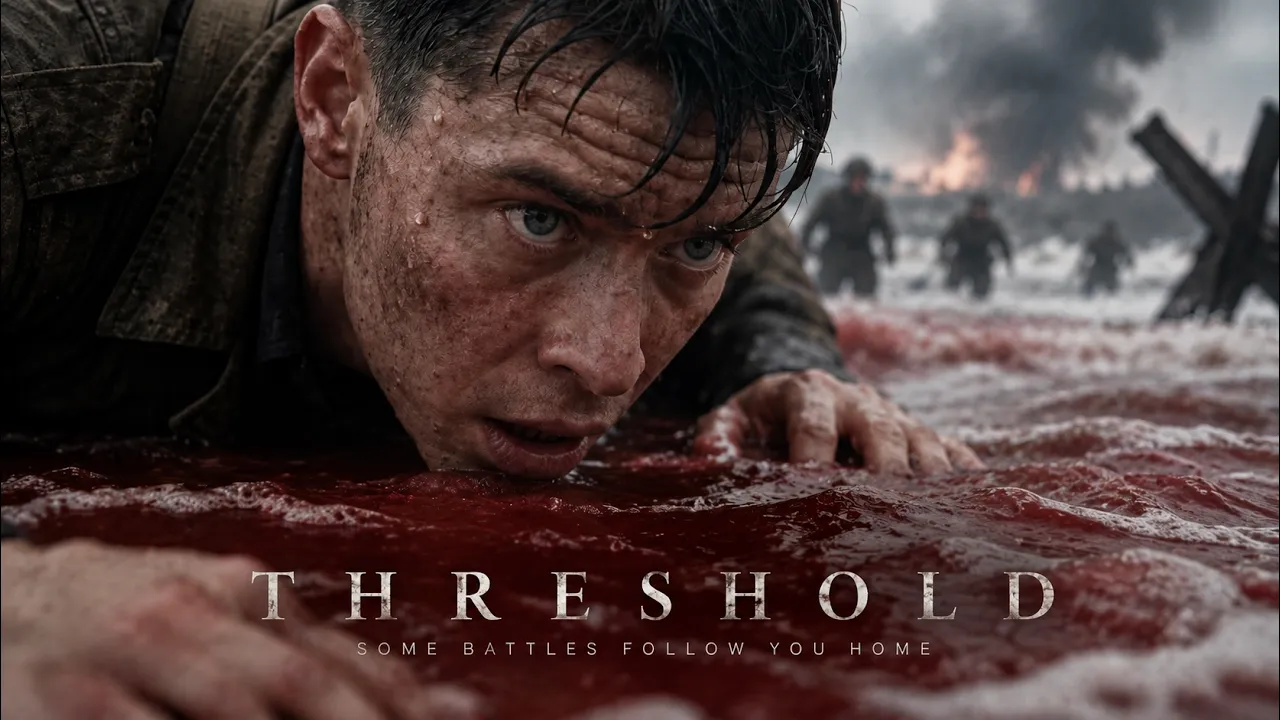
A generative short film about war, memory, family, and a young soldier’s longing to make it home.
✨ Context
Threshold began with a desire to tell a story about D-Day from an intimate, human perspective.
Rather than focusing on military strategy or the scale of the invasion, the film stays close to a single young soldier experiencing the chaos of Omaha Beach. Around him is one of the defining events of the Second World War. For him, however, the world has become much smaller: fear, survival, faith, family, and the overwhelming desire to make it home.
The film explores the idea of the “Threshold State” — the possibility that at the moment of death, consciousness may enter an altered state in which memories, people and emotions converge.
For the soldier, that threshold becomes a journey home.
There is also another meaning behind the title. Threshold was created during a remarkable moment in filmmaking, when generative technology is beginning to allow individual filmmakers to create images and experiences previously possible only with enormous crews, sets and budgets.
In that sense, the film exists at two thresholds: the threshold between life and death within the story, and the threshold between traditional and generative filmmaking. We are at that threshold.
🎭 Narrative
June 6, 1944.
A young soldier lands on Omaha Beach under overwhelming enemy fire. Men fall around him as he struggles through the surf, eventually finding temporary shelter among the beach obstacles.
Terrified and exhausted, he reaches beneath his uniform and grips the small crucifix hanging around his neck.
And the battlefield disappears.
The cold grey waters of Normandy become a peaceful English countryside. The noise of artillery becomes silence. Ahead of him are the people he has been desperately trying to return to.
He is home.
His family runs to meet him. Inside a warm country house, they embrace the soldier they feared they had lost. For a brief moment, everything he has endured appears to have led him back to the place he wanted to be.
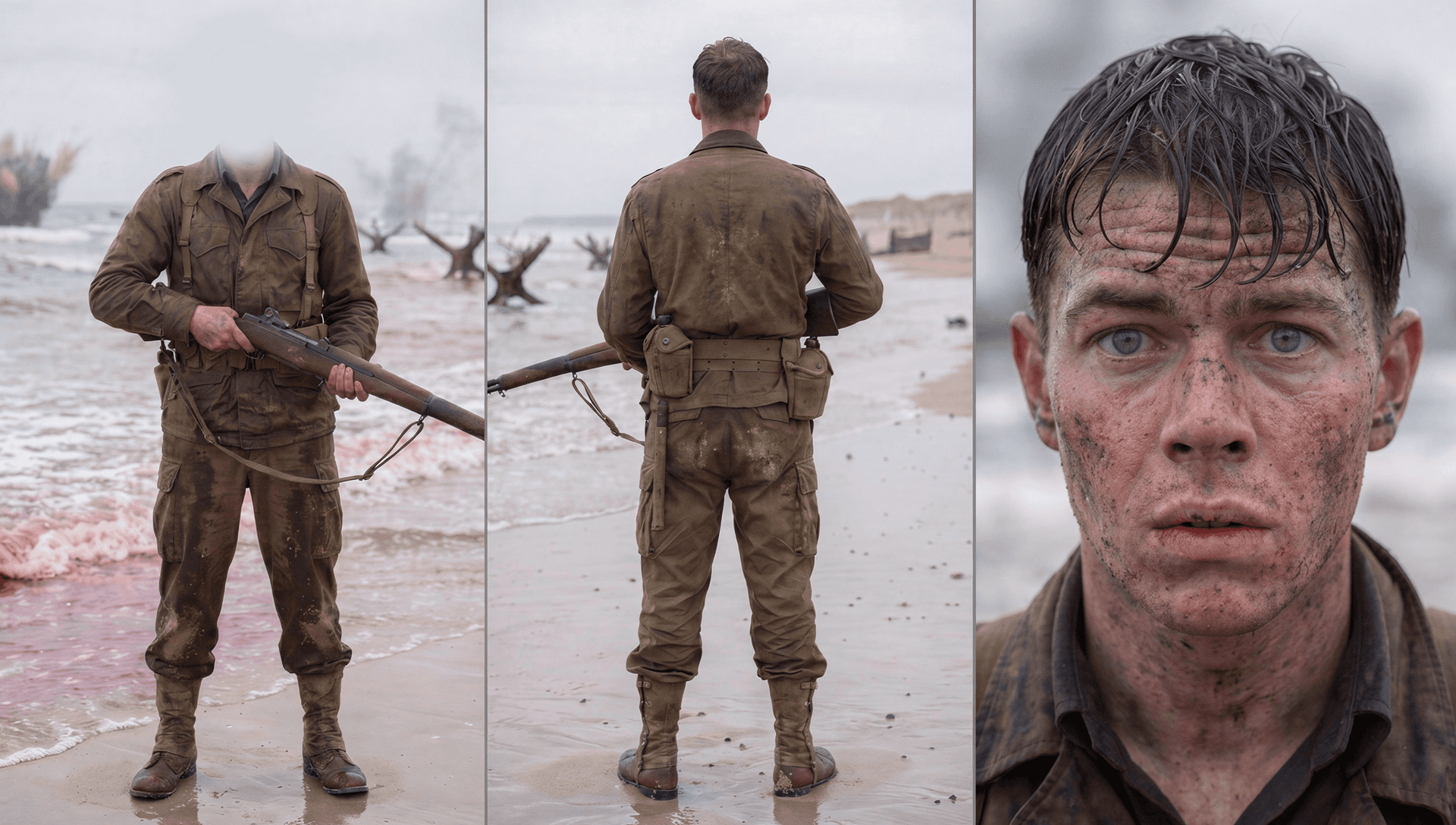
Threshold follows Thomas, a young soldier taking part in the D-Day landings, not as a war hero or historical figure, but simply as a frightened young man who desperately wants to survive and return home.
Thrown into the chaos of the Normandy invasion, Thomas experiences war at its most immediate and personal: the deafening violence of the beach, the men falling around him, the instinct to find cover and the fear that every few seconds might be his last.
But Threshold is ultimately less interested in the battle itself than in what is happening inside Thomas’s mind.
As the boundaries between the battlefield and home begin to blur, Thomas finds himself back with the people he has been fighting to return to. The terror of Normandy gives way to warmth, family and familiarity. He is welcomed home. He sits with the people he loves. For a time, the war seems impossibly far away.
But the film deliberately refuses to explain exactly what we are witnessing.
Is Thomas a surviving soldier whose traumatic memories of D-Day continue to intrude upon his life at home?
Is he experiencing the psychological effects of extreme trauma?
Or did Thomas never truly leave that beach — his consciousness retreating into memories, hopes and loved ones as he crosses the threshold between life and death?
The film leaves that answer to the audience.
Years later, in the present day, another young boy — also named Thomas — encounters the story of D-Day while visiting a memorial museum with his mother.
Like any child trying to comprehend something almost incomprehensible, he begins asking simple questions.
Were they scared?
Why did they fight?
His mother explains that they fought for the freedom their generation now enjoys.
Through the boy, the historical scale of D-Day becomes personal again. These weren’t simply soldiers in photographs or statistics in a history book. They were young people who were frightened, who had families, and who wanted to go home.
The modern Thomas finally asks the question at the centre of the entire film:
Did he ever make it home?
There is no definitive answer.
And that is where Threshold ends — leaving the audience to decide what “home” ultimately means.
Perhaps Thomas survived and carried the beach with him for the rest of his life.
Perhaps what we witnessed was the final refuge of a dying mind.
Perhaps, at the threshold of death, he really did find his way back to the people he loved.
The film doesn’t choose for us.
Instead, the two Thomases — separated by generations — connect the sacrifice of the past with the freedom of the present. One young man faced a beach not knowing whether he would ever return home. Decades later, another young boy is free to walk out of a museum holding his mother’s hand and go home.
That is ultimately what Threshold is about:
fear, sacrifice, memory — and the universal human longing for home.
🎨 Visuals
The visual language of Threshold is built around two deliberately opposing worlds.
Normandy is cold, chaotic and physical.
The D-Day sequences use desaturated blues, greys, dirty greens and the brown-red tones of churned sand and bloodied water. The camera stays close to the soldiers, surrounded by spray, smoke, explosions and movement. The intention was not to make the battle feel heroic or picturesque, but frightening, disorienting and immediate.
The soldier’s vision of home is the opposite.
The palette transforms into warm golds, greens and amber sunlight. A quiet English country lane replaces the exposed beach. The cold ocean gives way to the warmth of a family home. Instead of strangers dying around him, the soldier is surrounded by people who love him.
The contrast is intentionally almost dreamlike: war versus home, terror versus safety, death versus love.
Water also became an important visual and sonic motif. The film begins with the ocean, the soldier fights his way through it, and ultimately dies within it. The rhythmic sound of the surf connects to the idea of a heartbeat and the transition between physical reality and the threshold state.
The crucifix provides the film’s other central visual motif. It is something tangible that the soldier can hold onto when almost everything else has been taken away — a connection to faith, home and the world beyond the beach.
🎬 Production
Threshold was developed as a generative short film, using a filmmaking process designed to resemble traditional production as closely as possible.
The process began with the story rather than the technology.
The film was developed around the emotional journey of the soldier first: the landing, his terror on the beach, the transition into the threshold state, the imagined homecoming, his return to reality and finally his death.
From there, the film was broken into individual sequences and shots. Characters, costumes, environments and visual references were developed during pre-production so that the generated material could maintain continuity across the film.
The production effectively required creating several distinct locations:
Omaha Beach during the D-Day landings
The English countryside
The family’s 1940s home
Each sequence required its own visual language while still feeling as though it belonged to the same film.
Generative shots were treated much like takes on a traditional set. Shots were generated, evaluated and sometimes recreated to improve performance, composition, camera movement, historical atmosphere or continuity. Additional coverage could then be created where the edit revealed that another angle or emotional beat was needed.
The final stage brought those elements together through editing, sound design, music, pacing and colour work.
Sound became particularly important. The transition from gunfire, explosions and crashing surf into the peaceful homecoming helps sell the psychological transition as much as the imagery itself.
The goal throughout production was simple:
Don’t make an AI demonstration. Make an actual short film.
Human driven storytelling, using generative tools.
The technology was there to enable the images. Story, performance, editing, sound and emotion still had to make those images mean something.


Showreel
